
Indian and US Fintech Investors Are Converging. Here Is What the Data Shows.

Most founders treat Indian and US fintech investors as two entirely separate markets. Different check sizes, different fund structures, different theses. Raise from one or the other, not both.
AngelLinx Intelligence tracks live investor filings across both markets. The data from this week tells a different story. Indian and US fintech investors are not diverging. They are converging on the same theses, the same fund structures, and increasingly the same stage preferences.
Here is what the numbers show and what it means for founders raising in 2026.
The Thesis Is the Same on Both Sides
The most striking similarity between Indian and US fintech investors right now is where their conviction is concentrated.
In the US, AngelLinx Intelligence tracked Tribe Capital filing a dedicated $19.5 million fintech fund this week, the only sector-specific fintech vehicle among 43 VC filings in a single day. The mandate covers fintech and crypto infrastructure, with a specific emphasis on AI applied to financial services. Across the broader US fintech investor universe, the active theses in 2026 cluster around three areas: AI applied to underwriting and compliance, embedded finance with existing distribution, and real-time payments infrastructure.
In India, Fundamentum Partnership filed its third fund this week at Rs 2,200 crore (approximately $265 million — with an explicit mandate covering fintech, AI, and consumer technology). Fundamentum's fintech track record includes FlexiLoans (alternative lending), Stable Money (fixed-income investing), Olyv (credit), and TransBnk (banking infrastructure). The firm separately filed Fundamentum Frontier Trust with a dedicated AI mandate. The parallel structure (one fintech fund, one AI fund) is almost identical to how US-based multi-strategy investors are carving up their sector allocation.
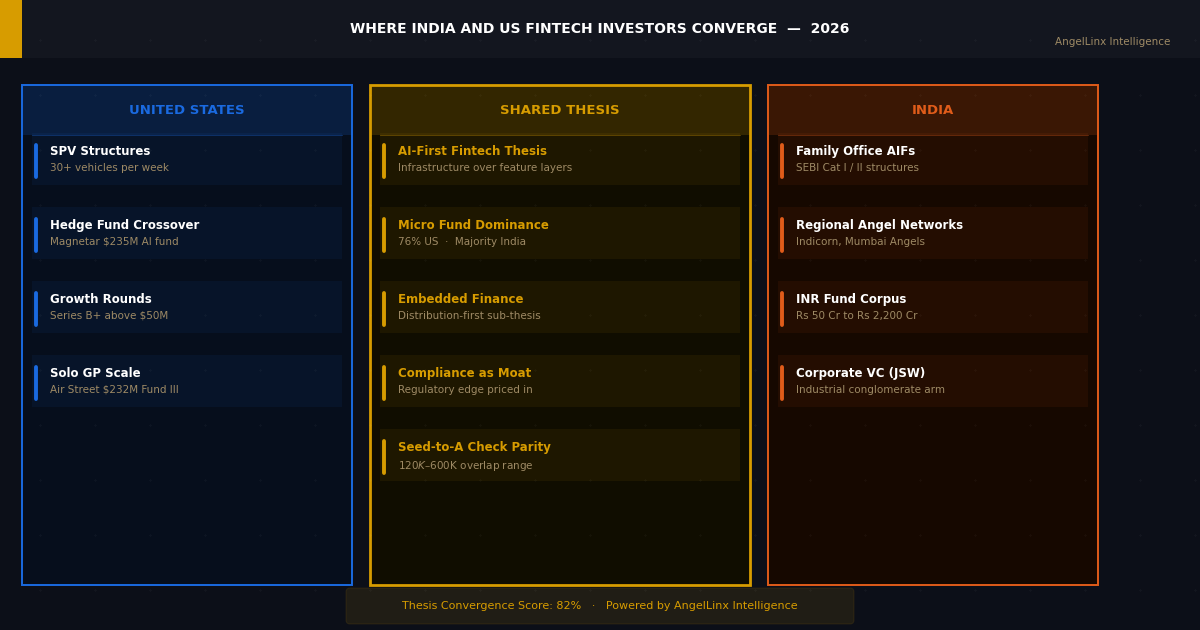
Both markets are backing the same thing: financial services companies where AI is the infrastructure layer, not the product surface. A founder building AI-powered underwriting for lenders is a fit for Fundamentum in Bangalore and for Tribe Capital in San Francisco. The geography is different. The thesis is not.
Fund Structures Mirror Each Other
The dominant fund format in both markets is small.
In the US, AngelLinx Intelligence tracked 182 VC fund filings across the week of August 3 to 7. Of those, 138 (76 percent) were raising under $5 million. These are solo GPs, emerging managers, and sector-focused micro funds writing $150,000 to $400,000 first checks with two-to-three week decision cycles.
India's SEBI-registered AIF universe shows the same pattern. The majority of newly registered Alternative Investment Funds are small vehicles: family offices, angel networks, and emerging managers with corpus sizes under Rs 50 crore. Indicorn Angels Trust, registered this week out of Delhi, runs a Rs 100 crore-plus network writing angel checks in consumer, apparel, and adjacent sectors. JSW Ventures Fund III is targeting Rs 450 crore, large by Indian standards, but equivalent to roughly $54 million, firmly in the micro-to-small fund range by US benchmarks.
The implication is structural: in both markets, the most accessible institutional capital at the seed stage comes from small vehicles with fast decision-making. The founders who default to pitching only the largest named funds (Sequoia, SoftBank, Accel in India; a16z, Sequoia, Lightspeed in the US) are competing for the smallest fraction of the available capital by fund count.
Check Sizes Are Closer Than Founders Think
The perception is that Indian investors write much smaller checks than their US counterparts. The reality at the seed stage is narrower than most founders expect.
US fintech seed checks from micro funds run $150,000 to $500,000. Indian angel networks and micro AIFs write Rs 1 crore to Rs 5 crore, approximately $120,000 to $600,000 at current exchange rates. The ranges overlap.
At Series A, the gap is more meaningful but still comparable. US-based fintech specialists write $2 million to $10 million. Fundamentum writes approximately Rs 100 crore ($10.5 million) per initial check at Series A. JSW Ventures targets Rs 15 to 20 crore ($1.8 to $2.4 million) at pre-Series A. The check sizes describe the same stage of company with similar capital needs. The difference is currency denomination, not order of magnitude.
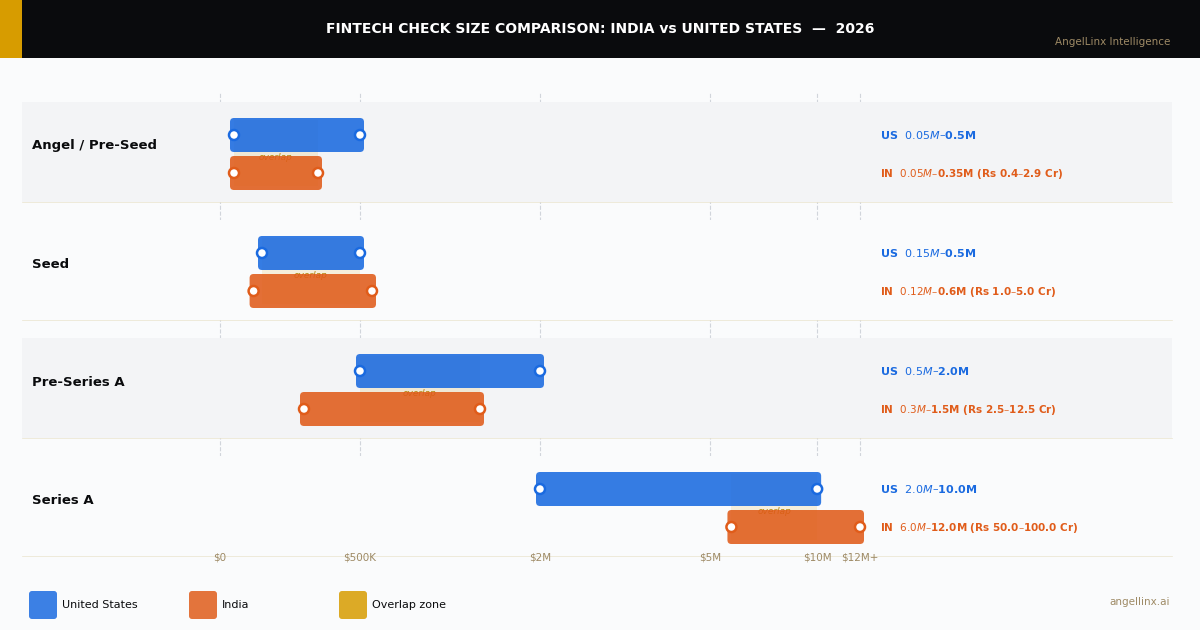
Where the markets genuinely diverge is at growth stage. US fintech investors have access to $100 million-plus growth rounds with multiple institutional participants. India's growth-stage fintech ecosystem, while expanding, is less deep. Founders raising a $50 million Series B have more options in the US than in India. But for seed and Series A, the capital markets are more similar than the conventional wisdom suggests.
Corporate Capital Is Entering Fintech in Both Markets
One of the clearer signals in this week's data is corporate VC activity on both sides.
In the US, Magnetar Capital, a $14 billion hedge fund, closed a $235 million AI venture fund anchored by PEAK6 Strategic Capital and Apex Fintech Solutions. That is institutional crossover capital from financial services incumbents entering the early-stage AI and fintech space. The motivation is both strategic and financial: financial services incumbents want access to the companies that will rebuild their industry, and they want to do it before those companies go public.
In India, JSW Ventures is the clearest corporate VC analog. JSW Group is one of India's largest industrial conglomerates, with revenues across steel, cement, energy, and infrastructure. JSW Ventures Fund III is targeting early-stage SaaS and platform companies with the same dual motivation: financial returns and strategic access to the technology companies that will affect JSW's core businesses.
Both markets are seeing the same dynamic: large incumbent capital flowing toward early-stage fintech and technology companies through dedicated venture vehicles, not through late-stage growth investments.
What the Convergence Means for Founders
The practical implication of India-US fintech investor convergence is that founders should not be building separate investor strategies for each market.
A fintech founder with traction and a compelling AI-enabled thesis is a fit for both Fundamentum in Bangalore and Air Street Capital or Tribe Capital in the US. The checklist investors are running through: AI as infrastructure, existing distribution, regulatory clarity, real-time payment rails, is largely identical.
The strategic question is sequencing. Indian investors tend to want to see India-specific traction before leading a round. US investors tend to evaluate the global opportunity more than the local proof point. For founders building cross-border, such as a payments platform that works in India and Southeast Asia or a compliance automation tool that spans both regulatory environments, the pitch architecture for each market should reflect that difference in emphasis, not a fundamentally different product story.
AngelLinx Intelligence tracks active fintech investors across both markets in real time: current fund cycle, deployment signals, thesis alignment, and check size range.
Browse active fintech investors: angellinx.ai/investors/fintech
Run a cross-market match based on your raise: angellinx.ai/investors/match-tool
Start your raise on AngelLinx. Free to sign up.
Data covers August 2026. Powered by AngelLinx Intelligence. Updated monthly.
Related Articles


Why Did One Venture Fund Account for 80% of All VC Dollars F...
AngelLinx Editorial Team
25 Sep 2026

Why Did One Hedge Fund File $18 Billion Under Three Differen...
AngelLinx Editorial Team
25 Sep 2026
September 24: $27.67 Billion Filed Across 122 Vehicles, Two-...
AngelLinx Editorial Team
25 Sep 2026