
Best Fintech Investors for Seed Stage Startups in 2026

Fintech is one of the most active sectors for seed investment in 2026. It is also one of the most mismatched.
Founders building in payments, lending, embedded finance, and banking infrastructure are pitching investors who look right on paper (sector match, stage match) and getting no response. The problem is rarely the pitch. It is usually a thesis mismatch or a structural incompatibility that basic research does not surface.
This guide covers who is actively writing fintech seed checks in 2026, what check sizes actually look like across different investor types, what these investors are focused on right now, and how to reach them.
How Active Is Fintech Right Now
Fintech seed activity in 2026 is running hot. $4.19 billion was raised across disclosed fintech equity deals in the first half of 2026 alone, with June being the most active single month.
More telling than the total capital number is where the formation activity is happening. AngelLinx Intelligence tracks live investor signals monthly across the market. In July 2026, 5,087 total investor signals were recorded across all sectors. A significant portion of that activity sits in financial services, across micro fund formations, SPV co-investment vehicles, and generalist funds with embedded finance mandates.
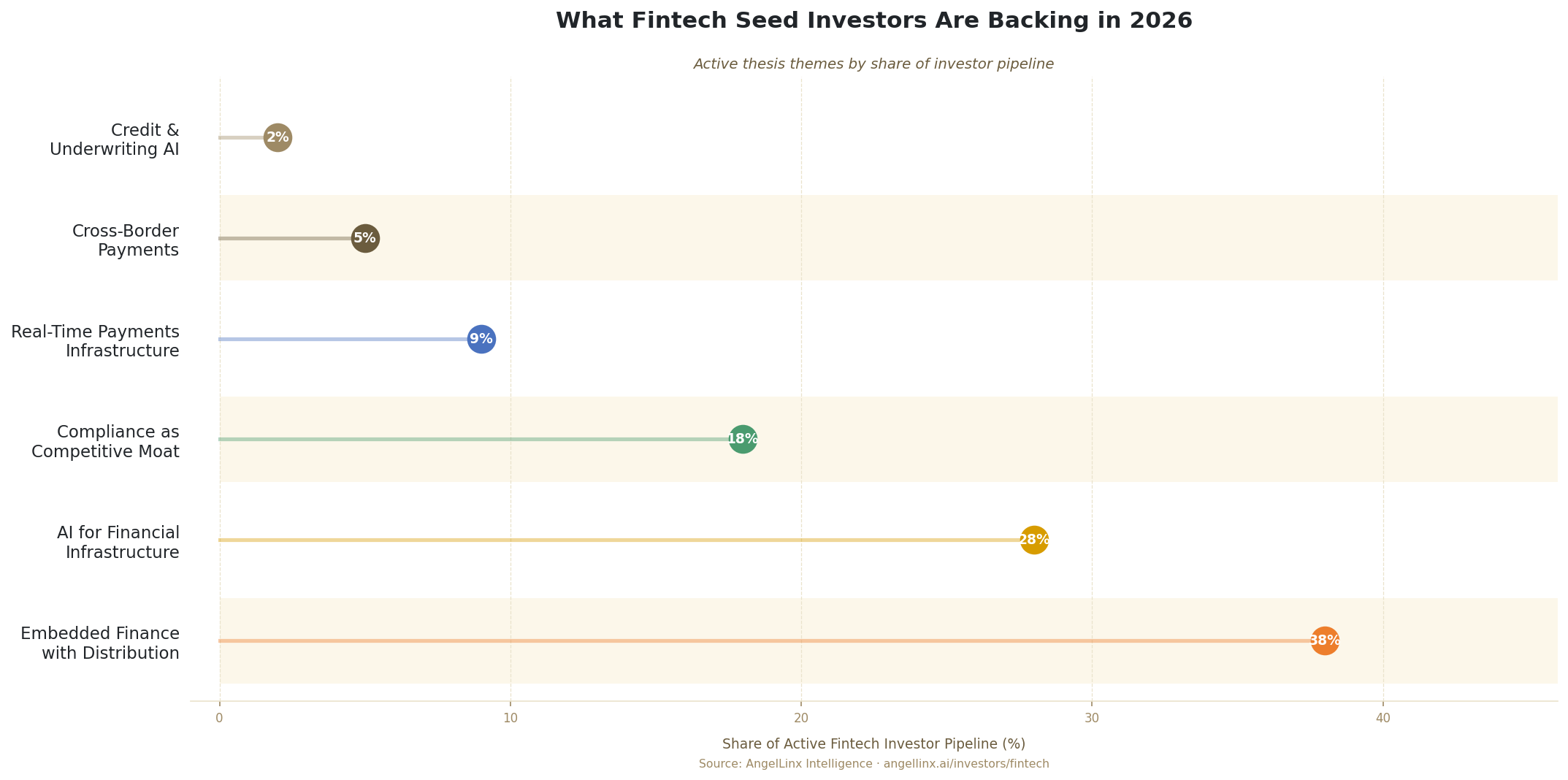
The shape of fintech investment has also shifted. Embedded finance now accounts for 38% of the fintech accelerator pipeline in 2026, up from 24% in 2025. AI-enabled financial services and compliance infrastructure are the two other dominant themes drawing capital. The generalist "fintech" label is increasingly inadequate. Investors in 2026 are backing specific sub-theses within financial technology, not the category broadly.
What that means for a founder: the investor who backed three payments companies in 2022 is not necessarily the right target for your lending infrastructure play in 2026. Thesis alignment at the sub-sector level is now the deciding factor.
Types of Investors Funding Fintech Seed Rounds
Understanding who the investors are, and what check range each type actually writes, prevents the most common structural mistake in fintech fundraising.
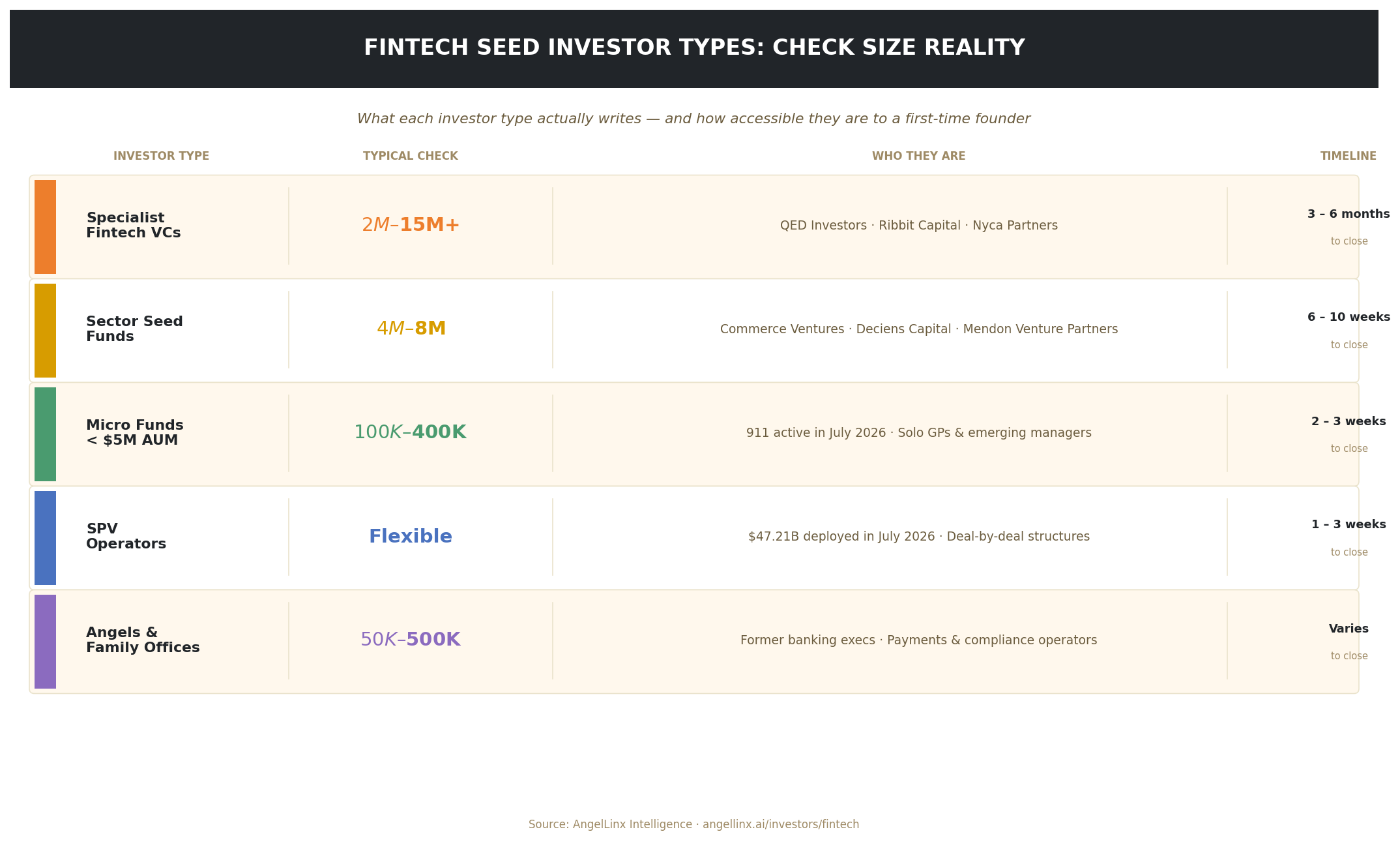
Specialist fintech VCs are the most visible and the hardest to access. Firms like QED Investors, Ribbit Capital, and Nyca Partners have deep sector expertise, regulatory networks, and portfolio companies that function as proof of thesis. QED writes checks from $2M upward through Series C. Ribbit's average seed-stage round size runs above $15M. These firms see extraordinary deal flow and have a high bar: existing traction, regulatory clarity, and in most cases a warm introduction from someone inside their portfolio network. A cold email to a QED GP rarely moves.
Sector-specialist seed funds are the more accessible tier. Commerce Ventures focuses on payments, banking, and retail technology infrastructure, with seed rounds averaging $5M. Deciens Capital invests pre-seed through Series A in next-generation financial services, with seed rounds averaging $7.8M. Mendon Venture Partners focuses specifically on fintech-meets-traditional-banking, writing $4M seed checks in that niche. These funds are smaller, more reachable, and have GPs who respond to founders with a genuine thesis fit.
Micro funds under $5M are the most systematically overlooked capital in fintech seed. In July 2026, AngelLinx Intelligence recorded 911 VC funds raising under $5M across all sectors. Many of these are solo GPs and emerging managers with a fintech or financial services focus, writing checks of $100K to $400K, moving in two to three weeks, and making decisions without committee process. They do not appear in standard investor databases. They are most active at the pre-seed and early seed stage, and they are often the fastest path to a first check for a founder without an existing VC relationship.
SPV operators are the fastest-moving capital in the market. In July 2026, SPV and deal-by-deal structures recorded $47.21 billion in total capital, a 54% increase from June. SPV operators raise vehicle by vehicle on companies they already have conviction on. In fintech, this often means experienced operators and former founders co-investing into regulatory-compliant infrastructure plays or embedded finance platforms alongside a lead VC. SPV operators are not leads. But they move fast, bring strategic value, and are often the bridge between a small first check and a larger institutional round.
Angels and family offices round out the accessible tier. Fintech angels, often former banking executives, payments operators, or compliance professionals, write $50K to $500K checks and provide domain credibility that institutional investors notice. Family offices are increasingly co-investing in fintech at seed and Series A, particularly in payments and embedded finance.
What Fintech Investors Are Actually Looking For in 2026
The stated mandate and the actual thesis are often different. Here is what the signal layer shows about active fintech investor focus in 2026.
Embedded finance with distribution already in place. The thesis investors want to fund is not embedded finance as a concept. It is embedded finance where a non-financial platform has already built user trust and is now layering financial products on top of existing distribution. The question investors ask is: why does this company win the distribution battle? If the answer is unclear, the embedded finance angle does not hold.
AI applied to financial infrastructure, not financial apps. The same pattern that showed up in AI/ML investing broadly, with a preference for infrastructure over applications, applies in fintech. Investors are backing AI applied to underwriting, compliance automation, fraud detection, and financial data infrastructure. An AI-powered consumer budgeting app competes with dozens of similar products. An AI-driven compliance layer for regional banks does not.
Compliance as a competitive moat. A fintech startup with a money transmitter license, banking charter, or established compliance infrastructure holds an asset that takes competitors 18 to 24 months to replicate. Investors in 2026 are treating regulatory positioning as a strategic advantage, not an operational detail. Founders who lead with the compliance roadmap as part of the pitch, not buried in due diligence, are getting a fundamentally different read.
Real-time payments infrastructure. The shift to real-time settlement is restructuring payment flows across B2B, cross-border, and consumer categories. Investors see this as a multi-year infrastructure buildout where early positioning matters. Founders building on or around real-time rails are in a category that specialist fintech investors are actively seeking.
What is not the right fit right now: another digital bank without a clear differentiated distribution channel, a payments processor competing on price alone with established players, or a consumer-facing financial product without a clear path to the regulatory requirements it will face at scale.
How to Approach Fintech Seed Investors
Warm introductions matter more in fintech than in most sectors. Fintech investing involves regulatory, compliance, and operational diligence that goes beyond standard software investment. Investors move faster with founders who arrive through a trusted referral because the baseline credibility check is already partially done.
For QED, Ribbit, and the major specialist VCs, the intro path is through portfolio founders. QED's portfolio includes Credit Karma, Nubank, and Remitly. Founders and key operators at those companies are the warm intro path. Ribbit's portfolio includes Robinhood, Coinbase, and Brex. Identifying a genuine connection, whether a shared operator, a product you use and have specific expertise on, or a mutual investor, is the entry point that a cold email cannot replicate.
For sector-specialist seed funds, the intro path is shorter. Commerce Ventures GPs are reachable through fintech founder communities, payments conferences, and shared investors in their portfolio companies. Deciens Capital is accessible through the broader early-stage fintech network. These funds have smaller teams and more reachable GPs than the large specialist VCs.
Timing matters at the fund level. An investor who recently closed a new fund has LP pressure to deploy. An investor in the final year of a fund cycle is focused on supporting existing portfolio companies and writing follow-on checks. AngelLinx Intelligence tracks fund deployment signals. Understanding where a specific investor is in their fund cycle changes whether outreach is worth sending.
The angle that lands is thesis-specific, not category-general. "We are a fintech company" tells an investor nothing. "We are building compliance automation for community banks, a $12B underserved market where the regulatory environment is tightening and incumbents are 10 years behind" tells an investor exactly where this sits in their thesis. Fintech investors in 2026 are looking for founders who understand the regulatory and structural context of the problem they are solving, not just the product surface area.
For micro fund GPs: outreach is more direct. These investors are often solo decision-makers who respond to founders who have done genuine research on their portfolio and can explain specifically why the check makes sense for that fund's thesis and stage. A targeted email with specific references to their portfolio decisions lands differently than a generic outreach.
Finding Active Fintech Investors Right Now
The investors listed above are established names. The more useful signal for a founder actively raising is which investors are deploying right now: not historically, but in the current month, from an active fund vehicle, with remaining capital to write new checks.
AngelLinx Intelligence surfaces active investors by sub-sector: payments, lending, embedded finance, and banking infrastructure, ranked by current deployment signals rather than historical activity.
Browse active fintech investors: angellinx.ai/investors/fintech
Run a free match based on your specific raise: angellinx.ai/investors/match-tool
Start your raise on AngelLinx. Free to sign up.
Data covers July 2026. Powered by AngelLinx Intelligence. Updated monthly.
Related Articles


Why Did One Venture Fund Account for 80% of All VC Dollars F...
AngelLinx Editorial Team
25 Sep 2026

Why Did One Hedge Fund File $18 Billion Under Three Differen...
AngelLinx Editorial Team
25 Sep 2026
September 24: $27.67 Billion Filed Across 122 Vehicles, Two-...
AngelLinx Editorial Team
25 Sep 2026