
Startup Fundraising Timeline: What to Realistically Expect at Every Stage
Varun R
Jun 2026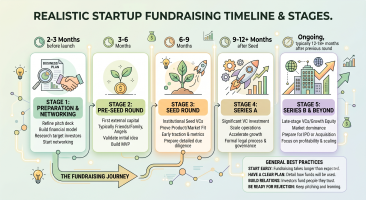
Startup Fundraising Timeline: What to Realistically Expect at Every Stage
Why Fundraising Always Takes Longer Than You Plan
Every founder who has raised capital will tell you the same thing: it took longer than expected. This is not bad luck — it is the structural reality of a process that involves dozens of independent decision-makers, each with their own timeline, conviction threshold, and portfolio constraints.
The key is not optimism. It is having an accurate map of each stage so you can allocate your time, preserve your runway, and avoid the panic of running out of cash before a term sheet arrives.
Pre-Seed Timeline (Idea to First Check)
Typical duration: 3 to 6 months
Pre-seed rounds are the hardest to time because they are the least standardized. Founders at this stage are often raising on the strength of team, insight, and early indicators — not revenue. The investor universe includes friends and family, angels, and a small subset of pre-seed funds.
The most time-consuming element at this stage is building the initial investor network from zero. Founders without warm introductions spend 60-plus hours per week just on outreach, follow-up, and logistics. TechCrunch's fundraising coverage consistently highlights that pre-seed rounds for first-time founders take 4 to 8 months on average.
Seed Round Timeline ($500K to $3M)
Typical duration: 4 to 8 months (or 4 to 8 weeks with the right infrastructure)
Seed is the most process-intensive raise. You are managing multiple investor conversations simultaneously, creating artificial urgency through time-bounding, running diligence processes in parallel, and negotiating terms — often for the first time.
Week 1-4: Preparation
- Finalize deck, model, and data room
- Build target list of 100 to 200 investors
- Brief any existing advisors or angels on your round
Week 4-10: Active Outreach and First Meetings
- Launch outreach campaign (email, LinkedIn, or AI-powered platform)
- Target 15 to 25 first meetings from 100 to 200 contacts
- Identify two to three potential leads early
Week 8-14: Second Meetings and Term Sheet
- Narrow to five to eight serious conversations
- Anchor on a lead investor; use their commitment to create momentum
- Set a close deadline (creates urgency without sacrificing terms)
Week 12-18: Diligence and Legal Close
- Share data room with committed investors
- Legal documents drafted, reviewed, signed
- Wire transfers received; round closed
Series A Timeline ($3M to $15M)
Typical duration: 5 to 9 months
Series A processes are more formal. Most institutional VCs run structured diligence processes involving multiple partner meetings, reference checks with customers and former colleagues, and external analysis of market size. NFX's fundraising research notes that founders who maintain strong investor relationships between rounds close Series A significantly faster.
How AI Platforms Compress Every Phase
The single biggest lever in fundraising timeline compression is reducing the time between outreach and qualified meeting. AngelLinx.ai reduces time-to-first-meeting from 90 days to 5 days by combining AI-powered matching with automated campaign infrastructure.
When you do not spend 80 hours per month on manual outreach, you spend that time on conversations, product, and customers — which is where fundraising momentum is actually built.
Compress your fundraising timeline starting today. Launch your campaign on AngelLinx.ai.