
How Long Does Seed Funding Take? A Realistic Timeline for Founders in 2026
Varun R
May 2026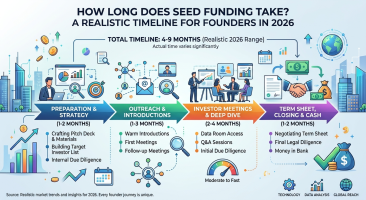
How Long Does Seed Funding Take? A Realistic Timeline for Founders in 2026
Target Keyword: how long does seed funding take | Est. KD: 3 | Est. Monthly Volume: ~1,300/mo
The Honest Answer Most Guides Avoid
Most fundraising guides tell you seed rounds take three to six months. The reality is closer to six to nine months when you account for investor discovery, meeting cycles, diligence, legal structuring, and wire transfer timing.
That said, a small and growing subset of founders are closing in four to eight weeks — not because they are exceptionally lucky, but because they are using fundamentally different approaches to investor discovery and engagement.
The Traditional Seed Funding Timeline (Month-by-Month)
Months 1-2: Preparation
Before outreach begins, founders typically spend four to eight weeks preparing: finalizing the pitch deck, building the financial model, structuring the data room, and assembling the target investor list. Founders who skip this phase extend the process later as diligence uncovers gaps.
Months 2-4: Investor Discovery and Outreach
This is where most timelines slip. Cold outreach via email and LinkedIn generates below 2% response rates, meaning a founder targeting 200 investors may secure fewer than four meetings. Each non-responsive lead requires three to five follow-ups, consuming weeks of calendar and mental bandwidth.
According to Crunchbase data on seed rounds, the median founder speaks with 40 to 60 investors before completing a seed round.
Months 4-6: Meetings and Soft Commitments
First meetings turn into follow-up calls, partner meetings, and reference checks. This phase typically involves 15 to 25 investor meetings to generate five to eight serious conversations. Timing investor decisions to converge — creating social proof and urgency — is a learned skill most first-time founders underestimate.
Months 6-8: Term Sheet, Diligence, and Legal
Once a lead investor commits, legal structuring takes two to six weeks depending on document complexity. Cooley's startup legal resources note that SAFE agreements close faster than priced rounds, often in two to three weeks. First-time deals with complex cap structures take longer.
What the Fastest Seed Rounds Have in Common
Founders who close in four to eight weeks share four consistent characteristics:
- Pre-built data room: Diligence does not pause after term sheet. Everything is ready before outreach begins.
- Intelligent matching: They are not pitching everyone — they are pitching investors whose thesis, check size, and sector focus align precisely.
- Automated follow-up: They never miss a follow-up due to calendar overload. Sequences run automatically.
- Verified investor network: They engage investors who have demonstrated recent, active deal flow — not passive observers on LinkedIn.
How AI-Powered Fundraising Compresses the Timeline
Platforms like AngelLinx.ai reduce the median time-to-first-meeting from 90 days to 5 days by combining intelligent investor matching with automated multi-channel campaigns. Instead of manually sequencing outreach across 200 investors, AngelLinx runs campaigns to 1,000-plus verified investors with personalized messaging and automated follow-up.
The result: founders spend 2 hours per week on fundraising instead of 20-plus, and close rounds in 4 to 8 weeks instead of 6 to 9 months.
Realistic Expectations for Your Round
Set a 90-day hard target for closing. Build your data room before your first outreach. Use intelligent matching to prioritize investors by thesis fit before volume. And invest in platforms that automate the operational burden so your full attention stays on the conversations that matter.
To start a fundraising campaign that compresses your timeline, visit AngelLinx.ai.