
Equity Crowdfunding vs Angel Investing in 2026: AngelLinx vs Republic
Varun R
May 2026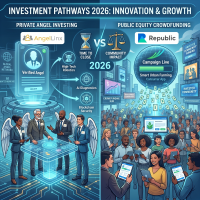
The Capital Decision That Shapes Your Company's Future
How you raise your first round does not just determine your bank balance. It determines who is on your cap table, what signal you send to institutional investors in your next round, and how much time you spend fundraising instead of building.
Understanding the Platforms: Republic vs. AngelLinx
-
Republic (Equity Crowdfunding): A leading platform operating under Reg CF and Reg A+ frameworks. It allows non-accredited (retail) investors to invest small amounts. It is best understood as community financing rather than institutional capital formation.
-
AngelLinx (Verified Angel Network): A platform built for the private capital market. Its network of 10,000+ investors consists of accredited angels, family offices, and institutional early-stage investors confirmed for active capital availability.
Side-by-Side Platform Comparison
| Criteria | AngelLinx | Republic (Reg CF) |
| Investor Type | Accredited angels, institutions | Non-accredited retail investors |
| Typical Check Size | $25,000 to $500,000+ | $500 to $1,500 |
| Investors Reached | 1,000+ verified, active | Public audience (marketing-dependent) |
| Time to First Meeting | 5 days (average) | Campaign runs 30 to 90 days |
| Regulatory Raise Cap | No cap (accredited rounds) | $5M per 12 months (Reg CF) |
| Cap Table Management | SPV pooling available | Hundreds/thousands of individuals |
| Follow-on Capacity | High (institutional backers) | Low (retail typically does not follow on) |
| Target Success Rate | 60 to 70% | Campaign-dependent |
Key Strategic Trade-offs
The Cap Table Problem
-
Crowdfunding (Republic): A successful campaign can result in 200 to 2,000 individual investors. This creates administrative obligations (reporting, proxy management) and can be seen as a "complexity signal" by Series A VCs.
-
AngelLinx: Uses SPV infrastructure to pool co-investors into a single entity. On your cap table, 20+ angels look like one investor, keeping it clean for future institutional rounds.
The Regulatory Ceiling
-
Republic: Reg CF rounds are capped at approximately $5 million per 12-month period as of 2024.
-
AngelLinx: No structural cap on raise size when working with accredited investors, making it viable for larger seed or pre-Series A rounds.
Marketing vs. AI Outreach
-
Republic: Conversion depends almost entirely on the founder's marketing effort (social media, PR, paid ads). It is a major 60-day marketing sprint.
-
AngelLinx: The platform's AI runs the outreach. It targets pre-qualified investors whose criteria match your profile. Founders typically spend only 2 hours per week on the process.
Framework: What Type of Capital Accelerates Growth?
| Dimension | Accredited Angel/Institutional (AngelLinx) | Retail Crowdfunding (Republic) |
| Check Size | $25,000 to $500,000+ | $500 to $1,500 |
| Follow-on Capacity | High | Minimal |
| Advisory Potential | High (Board seats possible) | None |
| Signal to Series A | Strong | Neutral to Negative |
| Cap Table Hygiene | High (via SPV) | Low (fragmented) |
| Regulatory Burden | Standard accredited | Ongoing Reg CF reporting |
Which Platform Makes Strategic Sense?
-
Choose Republic if: You have a strong consumer brand, want to build a public community of "believers," and your raise is within Reg CF limits.
-
Choose AngelLinx if: You need to raise from accredited investors quickly, want a clean cap table for VCs, need follow-on capacity, and prefer an automated process over a marketing campaign.
The Strategic Bottom Line: Crowdfunding builds a community; angel investing scales a company.
Start your fundraising campaign at angellinx.ai.
Sources: SEC Annual Report on Regulation Crowdfunding 2023; Cooley Venture Financing Guide; Carta State of Private Markets 2024; PitchBook Early-Stage Venture Report 2024; AngelLinx Platform Performance Data 2025.